
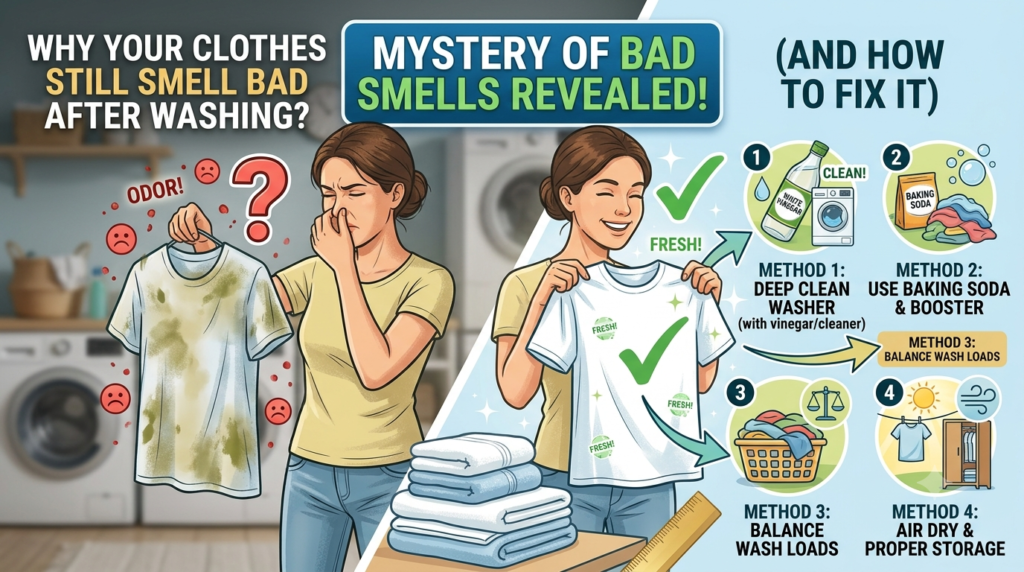
Why Your Clothes Still Smell Bad After Washing (and How to Fix It)
There is nothing quite as frustrating as pulling a freshly laundered load of clothes out of the washing machine, expecting a wave of clean fragrance, only to be hit with a stale, sour, or musty odor.
It feels completely counterintuitive. How can garments that just spent 45 minutes sloshing around in soapy hot water still smell bad?
The truth is, modern laundry habits and appliance designs have accidentally created the perfect environment for odors to thrive. When your clothes smell bad after a wash, it isn’t a sign that you need more detergent—in fact, it’s often a sign that you are using far too much. To fix the funk for good, you have to look at the underlying fabric chemistry and machine mechanics.
                       THE LAUNDRY ODOR DIAGNOSTIC

  THE SMELL         | THE LIKELY CAUSE           | THE ULTIMATE FIX
  ------------------|----------------------------|---------------------------------
  Sour / Mildewy    | Bacterial biofilm in drum  | Machine deep clean + open door
  Stale / Musty     | Detergent & wax buildup    | Strip with distilled vinegar
  Sharp / Pungent   | Trapped body oils (sebum)  | Switch to enzyme-based cleanser
The Root Causes: Why the Funk Lingers
If your clean clothes smell less than pristine, the issue almost always boils down to one of three common laundry mistakes.
1. The Soap Scum Scourge (Detergent Overdose)
It is tempting to think that more soap equals cleaner clothes, but the opposite is true. High-efficiency (HE) washing machines use very little water. If you pour in too much liquid detergent or heavy fabric softener, the machine cannot fully rinse it away.
This excess soap settles deep inside the fabric weave and coats the internal components of your machine, creating a sticky, slimy layer known as biofilm. This biofilm acts as an all-you-can-eat buffet for environmental mold spores and bacteria, which multiply inside your machine and transfer onto your clothes during the next cycle.
2. Trapped Human Sebum (Body Oils)
Roughly 70% of the soil on your clothes is invisible. It consists of body oils, sweat, and dead skin cells (sebum) secreted by your pores. Standard, budget-friendly detergents are great at washing away visible surface dirt, but they lack the specific biological components needed to break down complex lipids.
The oils get trapped inside the synthetic fibers of your activewear and casual clothes, hardening over time. When the fabric warms up against your skin as you wear it, those trapped oils heat up and release a sour, pungent odor.
3. The Closed-Door Trap
When you finish a load of laundry and immediately slam the washing machine door shut, you trap residual moisture inside a dark, airtight cylinder. Within hours, mold and mildew begin to colonize the rubber door gasket and drum casing. The next time you wash your clothes, you are essentially washing them in mildew-contaminated water.
How to Fix It: A Step-by-Step Restoration Plan
You don’t need to throw away your favorite shirts. You can completely reset both your garments and your appliance using a simple, science-backed approach:
Step 1: Deep Clean the Washing Machine
Before you can fix your clothes, you have to fix the machine cleaning them.
-
The Method: Pour two cups of distilled white vinegar directly into the empty drum and run a dedicated “Clean Washer” or heavy-duty cycle on the hottest water setting available. The acetic acid in the vinegar slices through the sticky biofilm and dissolves alkaline soap scum.
-
The Maintenance: Once the cycle finishes, take a clean cloth and wipe down the rubber door seal. Crucial: Always leave the washing machine door slightly cracked open between loads to allow the interior to dry out completely.
Step 2: Strip the Odor Out of Your Clothes
To break down the hardened layers of soap scum and body oils currently trapped in your smelly wardrobe, strip them using a natural acid wash.
-
The Method: Toss your smelly clothes into the washer. Skip the detergent entirely. Instead, pour 1 cup of distilled white vinegar directly into the fabric softener compartment or the main wash drum. Run a warm or hot cycle. The vinegar will break down the chemical bonds locking the odors to the fabric.
-
The Finish: If the clothes are exceptionally stubborn, run them through a second consecutive cycle with half a cup of baking soda to neutralize any remaining acidic odors.
Professional Garment Management for Odor Elimination
Consistently diagnosing fabric odors, running machine maintenance cycles, and precisely measuring specialized additives takes a considerable amount of weekly planning. For busy modern families, professionals, and corporate teams, dealing with laundry that keeps coming out sour is an exhausting drain on productivity.
Outsourcing your household apparel to a premium wash and fold laundry service guarantees that your items are processed using commercial-grade chemical auto-injection systems. These advanced systems automatically balance water hardness, calculate precise detergent ratios, and eliminate organic biofilms before they can root into your wardrobe. For fragile corporate attire, high-end wool coats, or heavily contaminated outerwear, utilizing an expert dry cleaners service ensures that oily residues are dissolved completely in a waterless environment, preventing fiber damage and completely eradicating stubborn musty scents.
The stakes for maintaining completely odor-free textiles are even higher across professional business sectors:
-
Boutique Airbnbs and Hospitality: Guest satisfaction depends entirely on sensory presentation. If a guest opens a linen closet and smells a hint of stale mildew on the sheets, your brand image drops instantly. Partnering with a dedicated airbnb laundry service provides highly disciplined, high-temperature sanitization that guarantees a neutral, fresh guest environment every single check-in.
-
Gyms, Spas, and Medical Operations: High-volume commercial facilities deal with massive amounts of sweat, massage oils, and biological materials daily. Trying to process these heavy items internally often results in overworked machines and sour odors. Utilizing a professional commercial laundry service keeps your staff uniforms and operational linens clean and compliant.
-
Fine Dining and Culinary Venues: Food grease, kitchen smoke, and spills quickly ruin high-end dining aesthetics if they aren’t properly extracted. A specialized tablecloth and linen laundry service relies on heavy industrial steam pressing and precise lipid-cleaving enzymes to deliver flawless, crisp, and beautifully scent-free tablescapes that elevate your entire dining room experience.
Conclusion
If your clothes still smell bad after washing, remember that your washing machine isn’t self-cleaning—it needs regular maintenance. By cutting back on excessive detergent, swapping out synthetic fabric softeners for distilled white vinegar, leaving the machine door open to air out, and using enzyme-based cleansers for body oils, you can easily keep your clothes smelling perfectly fresh and clean.
If you are tired of fighting laundry odor and want to reclaim your weekends from endless washing machine maintenance, let our fabric care exAperts handle the science for you. Contact Bolt Laundry today to check our straightforward local rates and schedule your first contactless door-to-door pickup.
